Hello everyone.
I realize and respect that the site is all about members making things for themselves and posting the results, but there are reasons I can’t do that.
I recently bought a Fostex mixing console (made in Japan in early 90s). The fader/slider caps are very unique. Usually, a tab on the slider pokes up and you simply pop any old cap on top.
Instead, these have the tab attached to the cap so it goes down through the surface and clips into the slider. Why they did this I do not know, but they are impossible to find. I would be so grateful to anyone who responds. One of these would fit in a box of 1 cubic inch, so they are small items. I would be able to send you one to copy. I live in the USA.
Thank you very much.
Phil
1 Like
Why not send some photos with some measurements and maybe someone can design a replacement that you could print or have a friend print locally?
Is it something like this?
Is the underside something like this?
or this?
It would look something like this but without proper dimensions it is a little difficult to design.
1 Like
Hello
Sadly, I am blind, although my ears still work. But I don’t know anyone who has a 3D printer.
Those pictures are from 2 different styles of mixer. #3 and 4 is how it would look for a “normal” slider, but as you can see from my pictures, instead of a “receiver” the Fostex 450 cap has what I can best describe as a “daggerboard” that goes down though the slot and locks into the slider. I can only attach one picture.
,
The cap is 200mm x 200mm.The daggerboard is 156mm. As you can see it has a T-shape to it. The thin part of the T is 68mm. The finger part is 50mm thick.
Does that help please?
Thank you
Phil
1 Like
WHOA. My metric is all bad!!
The cap is 20mm x 20mm
The daggerboard is cut in a T-shape. It is 15.7mm long overall, The bottom of the T that slots into the fader is 7.5mm
The top of the T is 8.5mm wide narrowing to 6mm at the bottom of the T.
The T is 2mm thick. Sorry about that.
Here is another pic:
Thanks
Phil
1 Like
The pictures and dimensions are really helpful. A few pictures directly looking at the sides and the top and bottom would be even better. I can probably put a quick model together for you. My concern is the flat plastic blade. Using an FDM printer the blade would probably be too fragile and break off. Maybe a resin printer would be better, although I don’t know how strong the blade would be on it. Another option would be to insert a metal blade through the plastic slider. That would ensure it wouldn’t snap off. I’ll see if I can prototype a model for you.
Based on your measurements and what I can see in the pictures I end up with something like this but I don’t think I have all the dimensions correct.
I am not quite clear on the measurements of the “T” shape.
1. What is the overall height from the highest point of the slider section to the bottom of the dagger end (the height with the slider sitting on a flat surface to the end of the dagger?
2. The height of the slider to where the dagger first protrudes from the slider (slider thickness)
3. The height of the dagger from where it leaves the slider to its very end
4. The height of the end of the dagger where it shape is a basic rectangle without the extra edge parts (triangular prisms)
1 Like
Printing it on edge with the dagger supported might keep the dagger portion from breaking as the lines of filament would be running parallel to the dagger portion.
Something like this
2 Likes
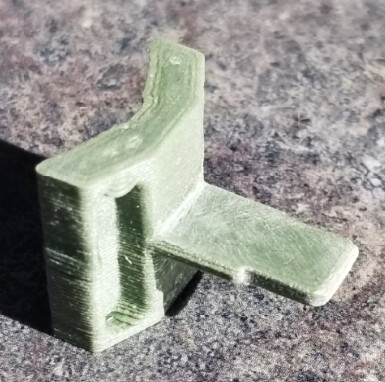
Here are some photos with measurements of a printed version.
I was wondering why my dagger end was 2.74 mm instead of 2 in my actual print until I realized that I was printing in PETG with the fan off and that part was printed over supports. After a little cleanup and some sanding to smooth the surfaces it was exactly 2mm thick. You can see the sagging on the bridging near the top on that side cutout. Those cutouts aren’t necessary but were in the original vacuum moulded parts. The print would be cleaner without them.
1 Like